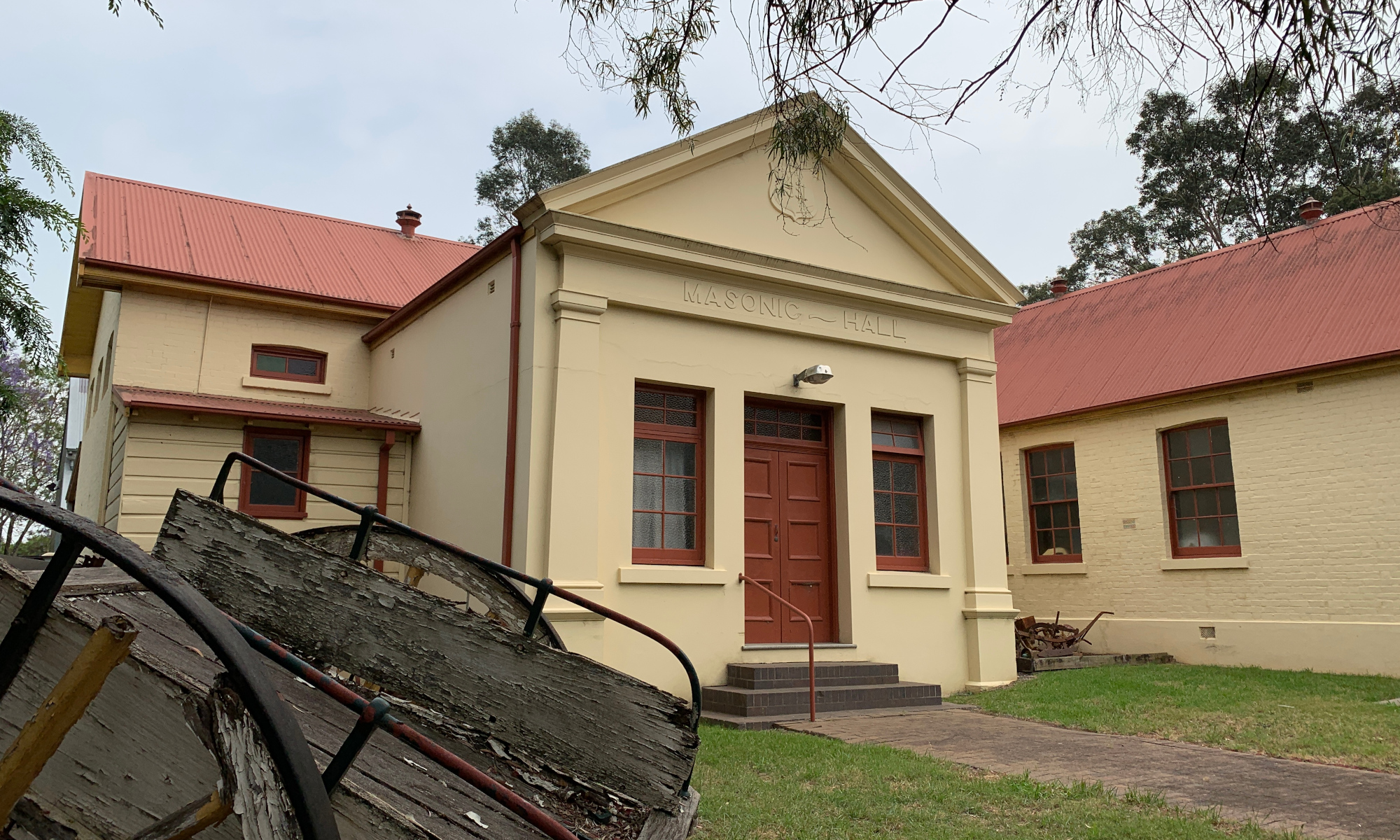
by Heather Smith
As I become a researcher of family history, I realise that I have been guilty of neglecting, and not listening to the stories my Grandfather told me, as he recalled memories of his wonderful life.
In 1964 my grandfather passed away aged 83 years. His passing and career was documented by Sydney newspapers. Fortunately my Mother had the foresight to keep some of these, from which I have been able to gain the story of my Grandfather’s boxing, political and business career, assisted by the book “Fighters of the North” by Bob Power (1976)
I was about 6 yrs old in 1942 when my Mother my two sisters and myself moved to the Royal Hotel Riverstone, to assist her parents, William & Mary Morgan, the licensees of the hotel. It was then I discovered my Grandfather had two names.
So now encouraged by the Riverstone Historical Society, I commenced researching and documenting the history of William Joseph Tyler Morgan citizen and Paddy King boxer.
Born in 1880, Will Morgan was the son of a former gold prospector from the Temora gold fields, who came with his wife Elizabeth to Wallsend in the Newcastle District NSW, in the late 1870’s. Later the family moved north to an orchard property at Muree near Raymond Terrace, where a young Will supplemented the family income, delivering the mail on his faithful grey mare “Fear Not”. For this he was paid 7/6 per week (75c.) He was a happy – go – lucky young Australian, unaware of his future as a great boxer who became triple national champion in the bantam, featherweight, and lightweight boxing divisions. An outstanding boxing performance which still goes down in boxing history.
He won his first boxing tournament at the age of 12 years in a local U/12 juvenile Tournament, defeating eight opponents to record his first fighting success. Around Newcastle boxing was slowly gaining respectable recognition, local tournaments were regarded as the nursery of budding professional fighters. Into this tough field went the diminutive 5’2” (157 cm) youth, with a reach of 65” (165cm), from the banks of the Hunter River. His sterling fighting attributes carried him onto further success in Open Newcastle tournaments. He was so successful that in a couple of years, promoters refused to take on the young boxer, as the amateur tournaments threatened to collapse.
In 1886 his family moved down to Sydney where young Will continued his interest in amateur boxing and physical culture, joining the Newtown Pastime Club. In 1899, after being unbeatable in the amateur ranks in Sydney, even after conceding a sharp rise in class and weight, he decided to travel to Tasmania.
Tasmania was enjoying a rich mineral boom and Queenstown a town of 14 pubs, plus 5,000 residents plus 2,000 navvies working on construction of the railway and a further 8,000 population at nearby Zeehan. The famous Queenstown Boxing Tournament attracted the best fighters in the Southern hemisphere and carried top prize money. It was an ambitious step for the teenager but he proved equal to the occasion, winning the rich bantam division, which added to his already imposing amateur record. He then travelled around the island circuit
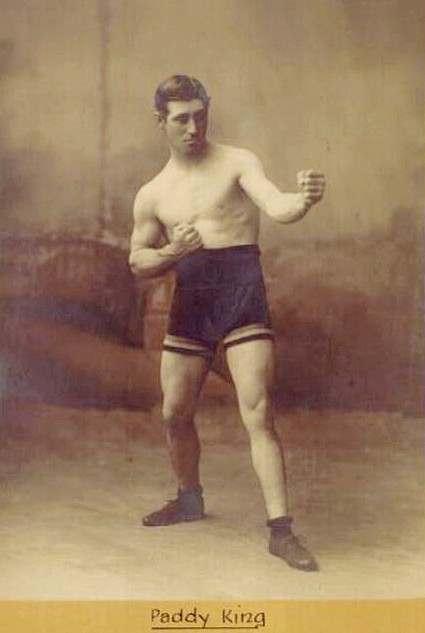
Photo: National Library of Australia. Ref: PIC/8395/644 LOC ALBUM 1049/14.
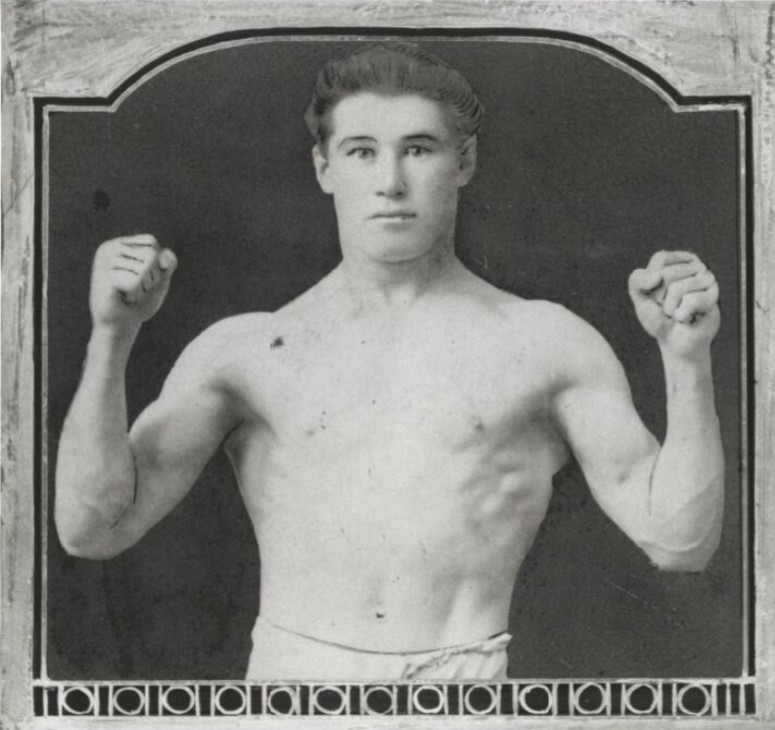
National Library of Australia. Ref: PIC/8395/64 LOC Album 1049/2.
finally chalking up a total of 22 victories. Returning home with a sizeable purse of 600 pounds (approx. $1200) he invested in a local business, retained the staff and continued his physical training and kept in good fighting trim.
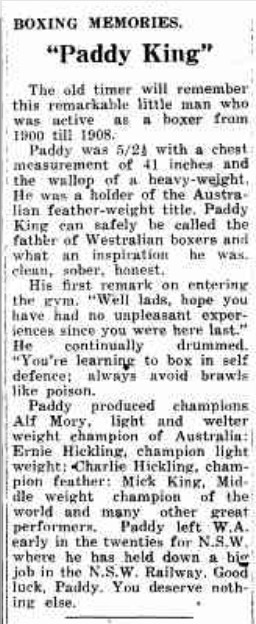
Once again running out of suitable opponents it was decided he would turn professional. His first professional fight under the name of ‘Paddy King’ was in Rosedale Hall, Tighe’s Hill against Danny Corbett. He scored a K.O. in the 4th round. At 17 years, he took the Australian bantamweight title from Frank Silver of Melbourne. He won his next title fight, defeating Billy McKell for the Australian Featherweight title in 1901
However tragedy also struck in 1901, for in a bout he did not want against his friend, Charlie Young on 24th August in the old Gaiety Theatre in the 16th round, a punch to his opponent’s jaw saw Charlie drop to the canvas unconscious. He was taken to hospital where it was found his skull was fractured and his case regarded as hopeless.
On 26th August Charlie Young died at Sydney hospital at 3.00am. King his seconds and other officials were charged with causing Young’s death. They were all acquitted at their trial at Central Court several months later and formally exonerated. Paddy swore he would never fight in New South Wales again. Unable to bear the sympathy of his friends, he left New South Wales and went west to the Kalgoorlie goldfields and Perth. There, regardless of size or weight, he was prepared to take on all comers.
The gold fields capital boasted a population of 90,000 citizens with a colourful background of gold rush living conditions where survival and success depended on physical capabilities. Entertainment facilities were limited and the cosmopolitan gold diggers found relaxation in drinking, gambling and fighting. Fighting with bare knuckle or glove fights attracted large crowds. Open challenges were issued in crowded pub saloons and fought in rough rings attracting large crowds.
Although he did not smoke, drink or swear, earning money on the goldfields was never a problem for Paddy King. Kalgoorlie was better lit than Sydney and had electricity and trams before New South Wales. He became one of Kalgoorlie’s top entertainers. Often he would return to his family in Perth after a couple of bouts with 700 to 800 pounds. ($1400-$1600). The illegal bare knuckle fights also earned good money in the smaller camps where he was often paid his winnings with gold nuggets. The now famous boxer Paddy King became one of the top drawcards in the West. Everything Paddy touched on the goldfield turned to money. He invested in a Kalgoorlie hotel and added to his small fortune. More often than not, when he opened the till, there were more gold nuggets than notes.
My grandmother, Mary Thomas, his long time sweetheart from Kurri Kurri New South Wales travelled to Perth where they were married. My grandmother told us she first met my grandfather on Newcastle railway station. She was standing on the station when a huge gust of steam from the engine momentarily blinded her. My grandfather, a young man, was also standing in the station and when he saw what happened he walked over to her and took off her glasses wiped them clean and placed them back on her eyes.
Now a family man with a son Jonathon “Bonnie” and two daughters Margery and Pertha, Paddy King decided to retire from boxing. He was a broken man when Bonnie died from a burst appendix at the age of 10. His final ring appearance came in 1910 in an overweight bout for the Western Australian heavyweight title. Coming up to scratch at 9st.2lbs Paddy gave his 13st.2lbs opponent Bert Keenan a boxing lesson to win by K.O.
His record totalled 338 bouts over a period of 13 years. The fighting days of Paddy King in the ring were over and in 1915 the former champ enlisted in the first AIF as a physical training instructor. In 1916 at Black Boy Military Camp, the explosion of a large field gun rendered him unfit for further service, and he was invalided out of the Army. This ended all plans of a further sporting career. However like many elite counterparts he could not settle down to the hum-drum style of his peaceful profession as a publican at the Federal Inn, Collie and the Club Hotel, Watsonia. It was decided that my grandparents and their two daughters would return to Newcastle in New South Wales.
|
|
|
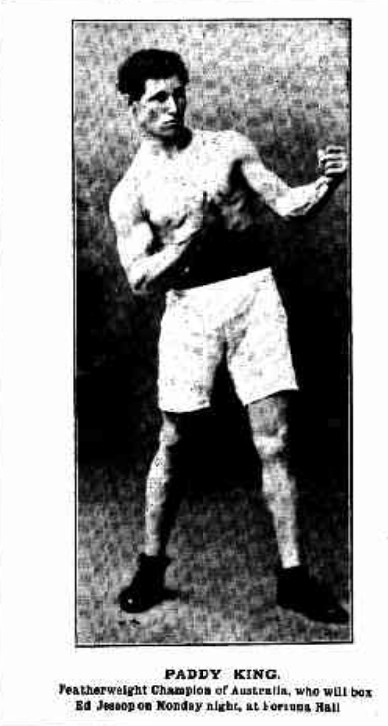
In the early 30’s John Thomas Lang was Premier of NSW. He required six suitable individuals with experience in the industrial field for appointment as Conciliation Commissioners for the NSW Government. William Morgan immediately received nomination by the Labor Government. He brought to his new position experience as a working man and a successful business man. Following his appointment, he came under strong verbal attack from the National Party opposition, with scathing remarks on the appointment of an ex-pug to such an important position. Many prominent citizens came to his defence. Jim Donald, a leading sports writer, wrote in his defence “since retiring from boxing Paddy King’s career forms an imposing record of civic achievements”. Other leading citizens spoke in his support and once appointed he went on to discharge his duties in exemplary style.
Some years later the “Nats” gained control of the Government and promptly terminated Commissioner Morgan’s services. The Bavin Government decided to dismiss the Commissioners three years before their term of office were due to end. It offered them a thousand pounds ($2000) each a years salary in lieu of notice. He refused to accept the money on the grounds that their actions were illegal.
He then proved that his fighting career was far from over as he took the NSW Government to litigation and won his point. At the completion of his appointed term, he stepped down from office, with the mutual respect of both employer and employee organisations to resume civilian life. He took over as Licensee of the Plough & Harrow hotel in Camden, and finally when the war was over and his son-in-law, my father, George Watson came home, we moved to the Royal Hotel, Riverstone NSW.
He maintained his physical fitness all his life and believed walking was his greatest mainstay and rain, hail or shine he strode 2-3 miles per day. My father would stand by ready to go to his aid when any young guns would call “the old pug” to come outside and they would show him how to fight. My small grandfather would move his steel rim glasses to the top of his forehead and dispose of the challenger in 2-3 quick punches. My Dad said all the young guns of the town had a new respect for the old pug and often came to him for boxing tips.
My grandfather passed away in 1964. In a fitting epitaph, in recognition of the dual lifetime role as fighter Paddy King and leading citizen William Joseph Tyler Morgan, on his passing it was said “The history of Australian boxing is replete with remarkable characters but few if any have had such a varied career as Paddy King, a fighter and gentleman to his knuckles. A Christian soldier who read the Bible daily, a total abstainer, clean living and clean tongue. A splendid type of citizen, sturdy, honest and self- respecting to whom many young fighters owe their moral and physical success.”
References:
Tough Australian Fighter Took On State Government After Retirement (Mirror 1958)/ Opponent died after blow. (The Sun-Herald 1964)/ Fighters Of The North – Bob Power (1976).